when you want, where you want.
From Homebase to homes of the future: Here’s how KC-connected Qwext landed its GFiber partnership
When Blake Miller talks about smart buildings, he isn’t theorizing from afar.
He’s tracing a line that runs straight through Kansas City — from early smart-city experiments and public Wi-Fi infrastructure to a new partnership with GFiber that aims to reshape how residents experience internet access and daily digital life inside apartment buildings.
Miller, founder of Homebase.ai and longtime civic technologist, is now helping lead a collaboration between GFiber (formerly Google Fiber) and Qwext, which acquired his proptech startup’s in 2023. A recent deal between the two blends three-gig symmetrical fiber, Wi-Fi 7 and smart-community software into a single managed system for multifamily housing.
Launching Homebase in 2016 as an outgrowth of local smart city work, Miller said, he saw a number of “awesome partners — the likes of KCMO, Cisco, and Sprint — come together for a $35 million public-private partnership.
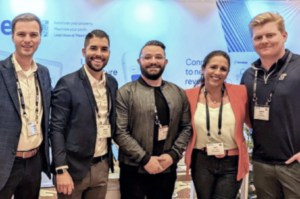
Homebase team members in 2023; courtesy photo
His startup then laid the groundwork for what would become Qwext’s broader smart-community platform. Today, Qwext connects internet service, access control, thermostats and building systems through one resident-facing app, while GFiber supplies the network underneath, Miller explained.
“We focus on building smart communities for apartment buildings,” he said. “That’s connecting apps to everything from access control — all the different locks on the building — to changing your thermostat and even getting connected to the internet all through the same app.”
From smart city experiments to smart apartments
Miller’s career intersects closely with Kansas City’s evolution as a test bed for connected infrastructure. Before Qwext, he worked through Think Big Kansas City and on early smart-city pilots that coincided with Kansas City becoming Google Fiber’s first metro market in 2012.
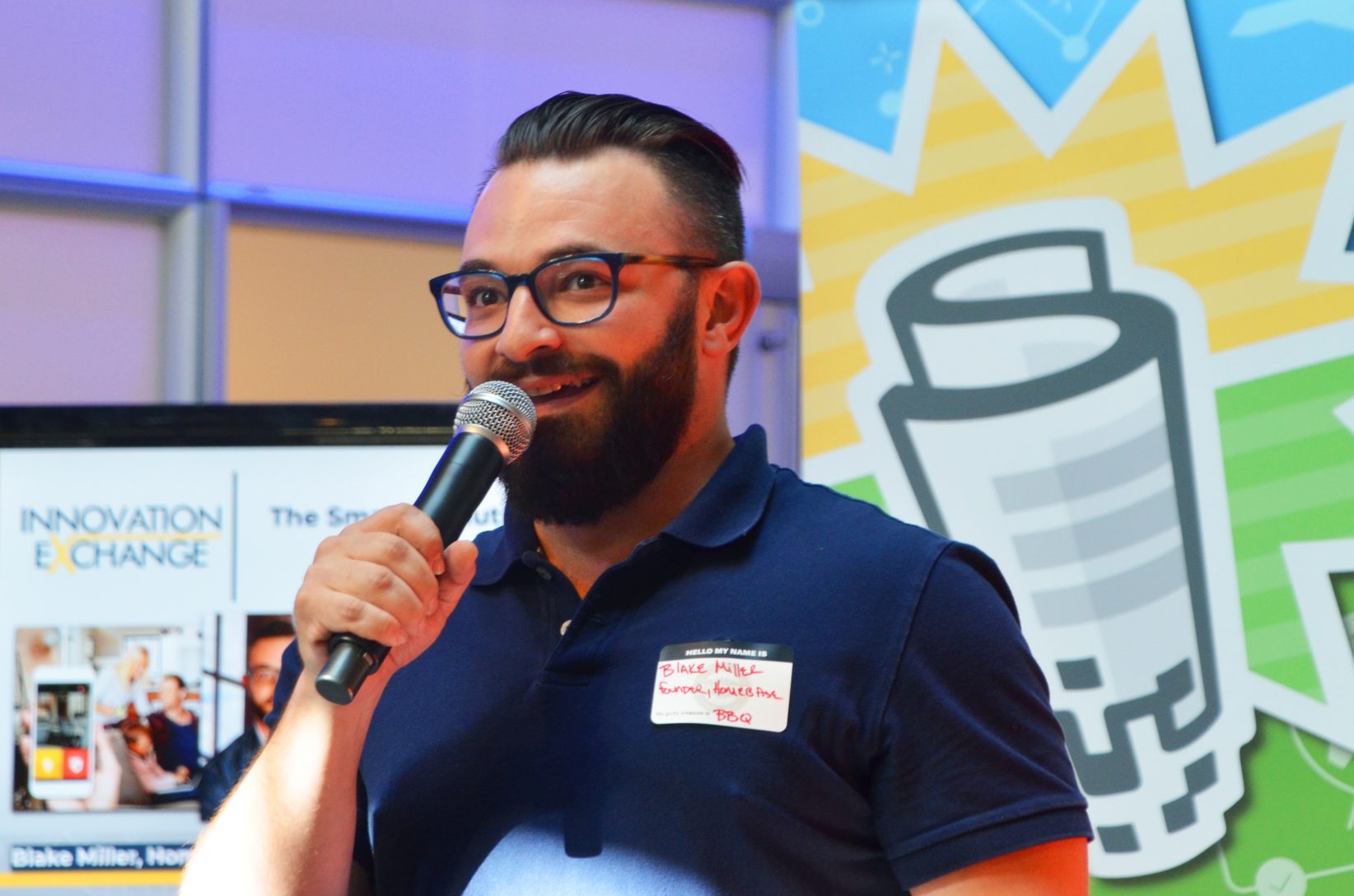
Blake Miller discusses Homebase’s smart tech during a Startland News event in July 2019; photo by Tommy Felts, Startland News
“The smart city project doesn’t happen without Kansas City becoming the first Google Fiber market,” Miller says. “All of those things are the chain of events.”
That lineage matters now.
Qwext’s partnership with GFiber isn’t just about faster speeds; it’s about simplifying how connectivity is delivered and managed inside apartment buildings — an area that has long frustrated residents and operators alike.
According to Miller, Google Fiber approached Qwext after hearing from large apartment operators who wanted more than gigabit internet.
“They wanted to really take things to the next level,” Miller said. “Google was in the position to start offering faster speeds, but they didn’t have a smart community solution. That’s where we came together.”
What the partnership actually changes inside apartment buildings
At the core of the partnership: a managed Wi-Fi product designed primarily for new multifamily construction. Instead of routing a single shared circuit through an entire building — a common industry model — GFiber delivers a full symmetrical three-gig connection to every apartment unit, layered with Qwext’s software and Wi-Fi 7 hardware.

Nick Saporito, GFiber
Nick Saporito, head of product at GFiber, said the approach marks a structural shift.
“Most traditional managed Wi-Fi deployments dump one 10-gig circuit to the entire building,” Saporito says. “We’re not doing that. We’re delivering a full three gig to every unit in the property.”
Residents create a personal Wi-Fi network when they move in — one that follows them across common areas.
“That Wi-Fi name and password follows them all over the property,” Saporito said. “They basically have a personal network that just follows them everywhere they are.”
The system also supports wired multi-gig connections and Wi-Fi 7 speeds approaching two gigabits on compatible devices — a jump aimed at remote workers, content creators and residents with high bandwidth demands.
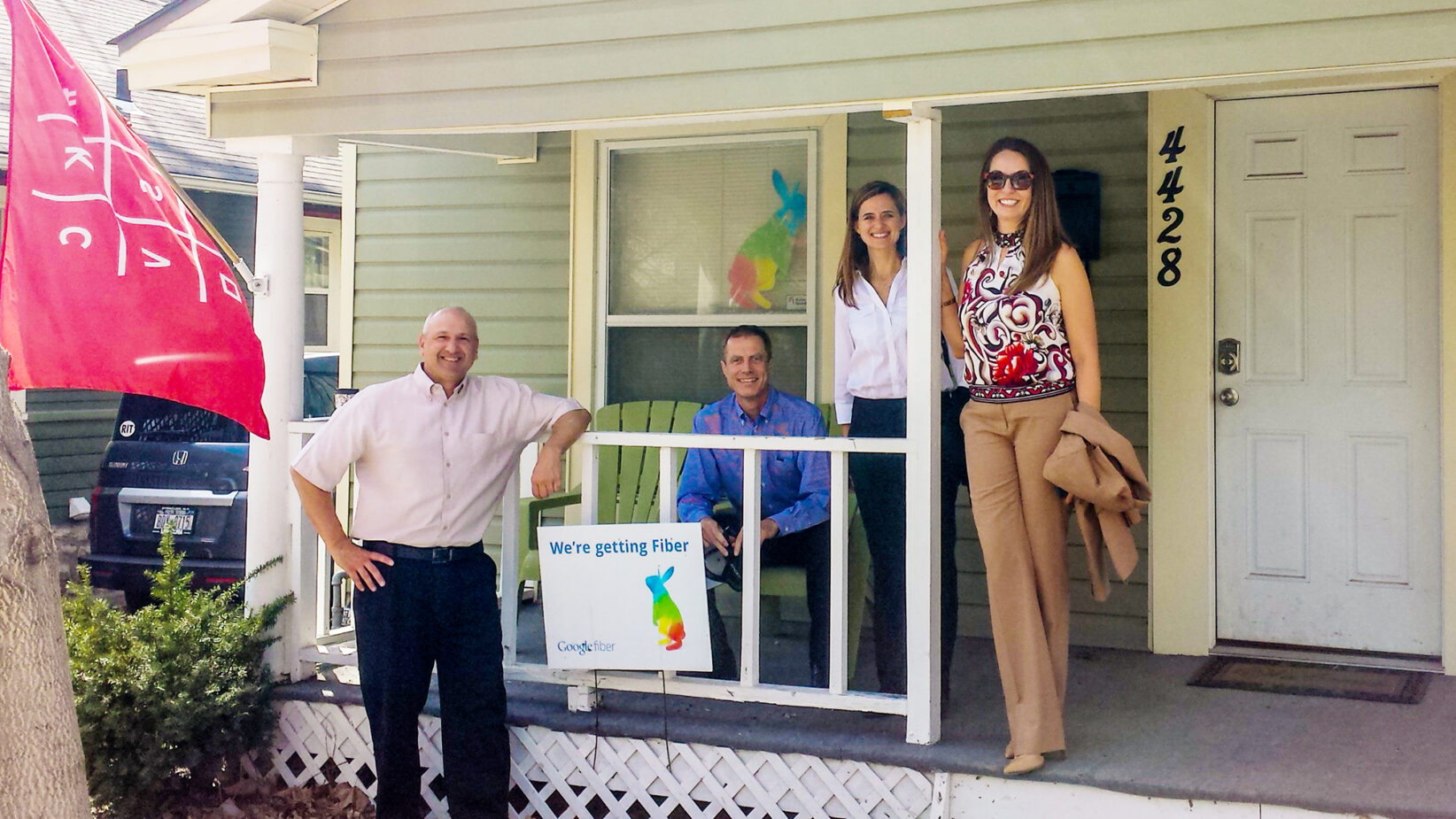
Officials from Google Fiber stand in April 2015 on the front porch of the first home in the world to receive Google Fiber installation in what was the Kansas City Startup Village on Stateline Road in Kansas City, Kansas; Startland News photo
Why Kansas City is still still ground zero for GFiber
“We always call Kansas City our hometown,” Saporito said. “This was our first market. This is where we started.”
That connection is operational, not symbolic. GFiber’s core operations, go-to-market and product leadership teams are still anchored in the region — including Saporito himself, who lives in the Kansas City area.
“Kansas City has never been left behind with us when it comes to technology investments,” he said. “I’m always proud to say that.”
Over the past two years, GFiber quietly upgraded nearly its entire national network by replacing electronics rather than digging up fiber — allowing markets like Kansas City to support 10-gig and even 25-gig capacity.
“Kansas City was the first market we did,” Saporito said. “Everybody internally thought I was crazy. But now Kansas City has the exact same network as our brand-new market, Las Vegas.”
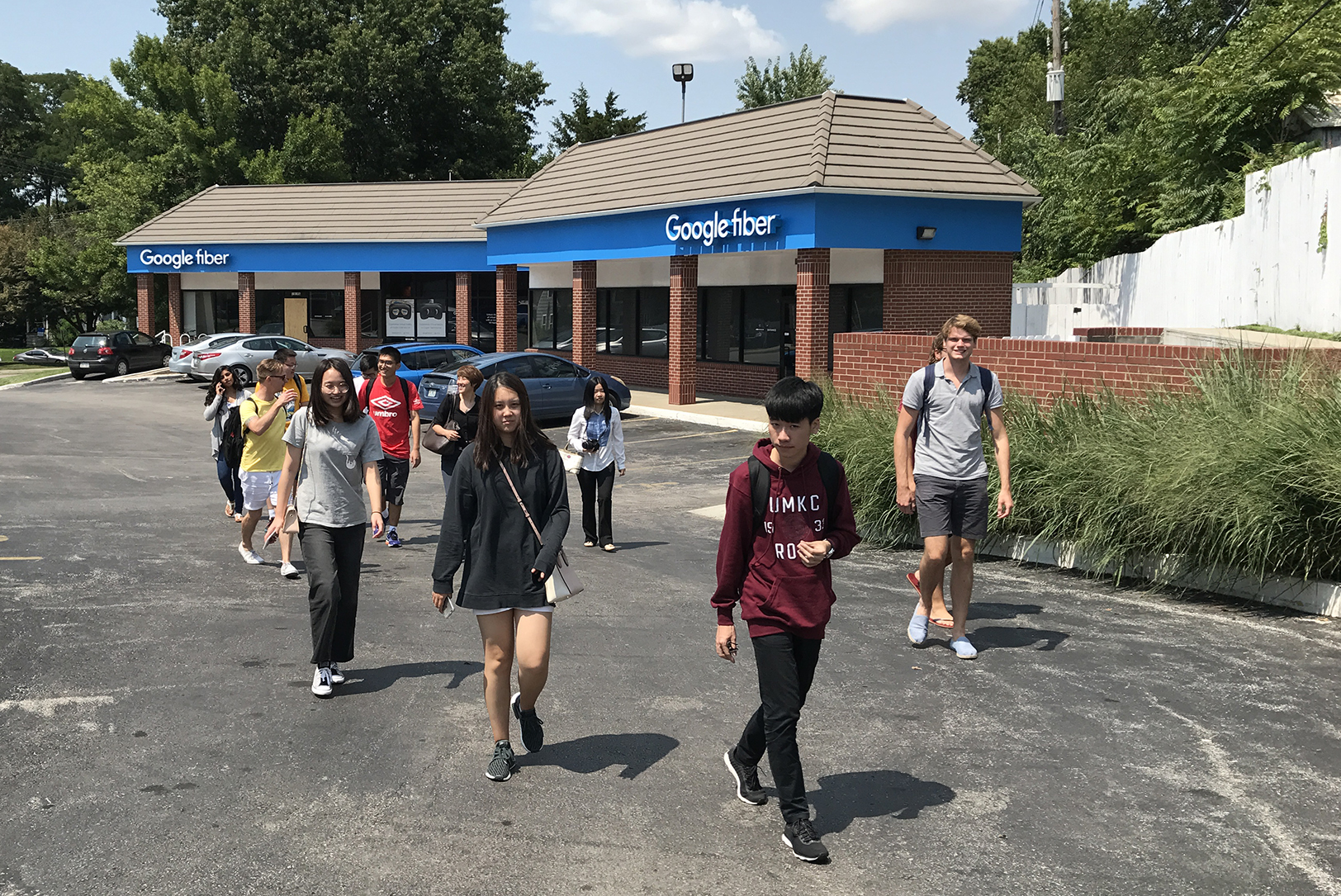
A group of students leaves the former Google Fiber headquarters in August 2017 at the intersection of Westport and Stateline roads for a tour of the Kansas City Startup Village; Startland News photo
How Qwext and GFiber approach security and resident privacy
Smart buildings often raise questions about privacy and security, Miller said, noting Qwext intentionally avoids always-online locks, opting instead for systems that require physical proximity via Bluetooth or NFC.
“Our locks are actually not on the internet,” he explained. “Your phone becomes the gateway to talking to that lock. You have to be right there.”
GFiber’s managed Wi-Fi uses enterprise-grade security protocols and does not block VPNs or resident-level privacy tools, Saporito added.
“Our default position is we would never try to block that from an end-user customer,” he said.
What’s known — and what isn’t — about the rollout
The partnership is rolling out primarily through new apartment developments, where construction timelines can stretch 18 to 30 months. Interest, Saporito says, is already strong across GFiber’s national footprint — including Kansas City.
“Our pipeline is quite healthy,” Saporito said. “This is available across our entire footprint in every metro.”
Zooming out, Miller views the collaboration as part of a longer arc tied to Kansas City’s role in early fiber experimentation.
“This is a continued innovation story coming out of here,” he said. “Google Fiber working with local startups to continue bringing the best, fastest internet to the world.”
Haines Eason is the owner of startup content marketing agency Freelance Kansas. Previously he worked as a managing editor for a corporate content marketing team and as a communications professional at KU. His work has appeared in publications like The Guardian, Eater and KANSAS! Magazine among others. Learn about him and Freelance Kansas on LinkedIn.
The post From Homebase to homes of the future: Here’s how KC-connected Qwext landed its GFiber partnership appeared first on Startland News.